


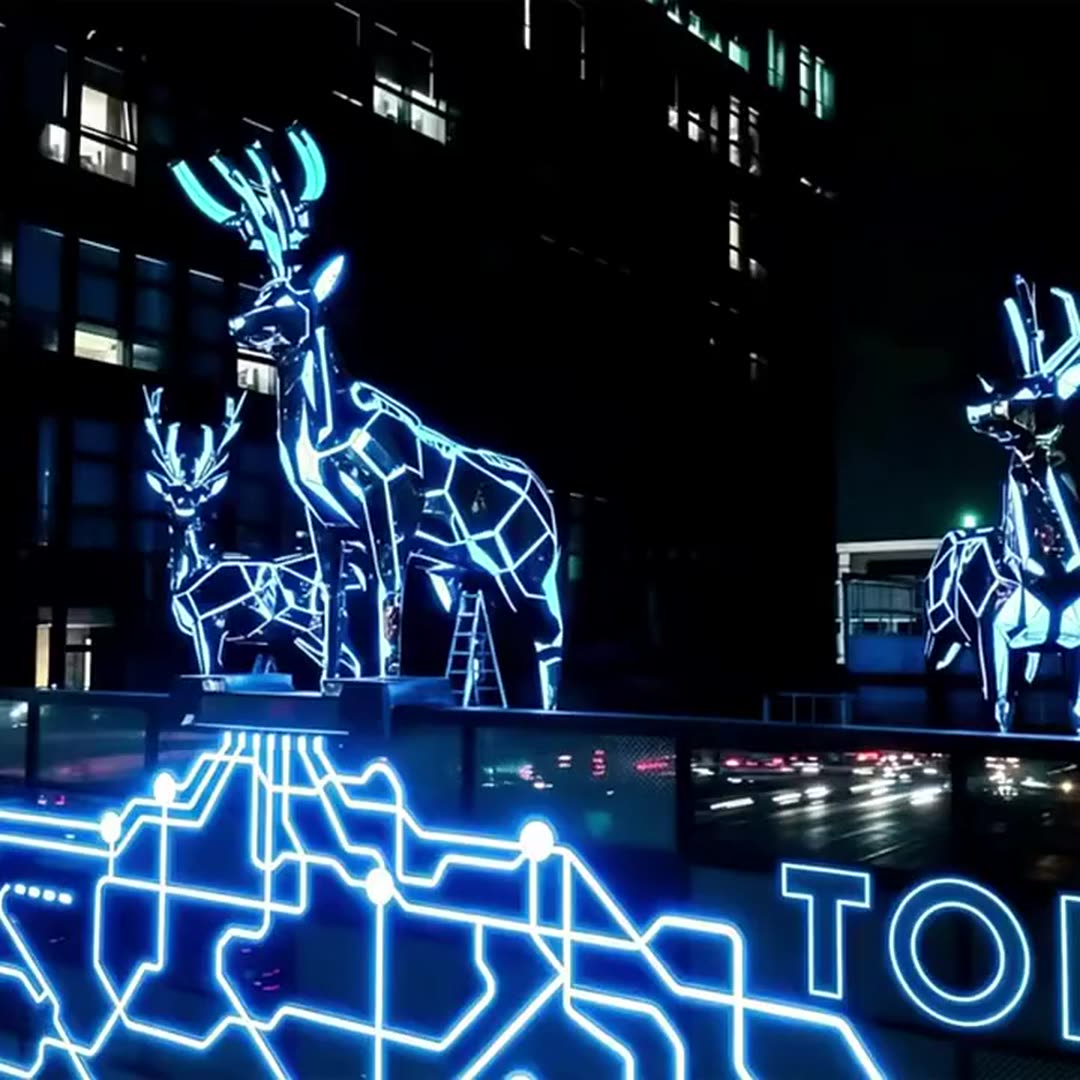
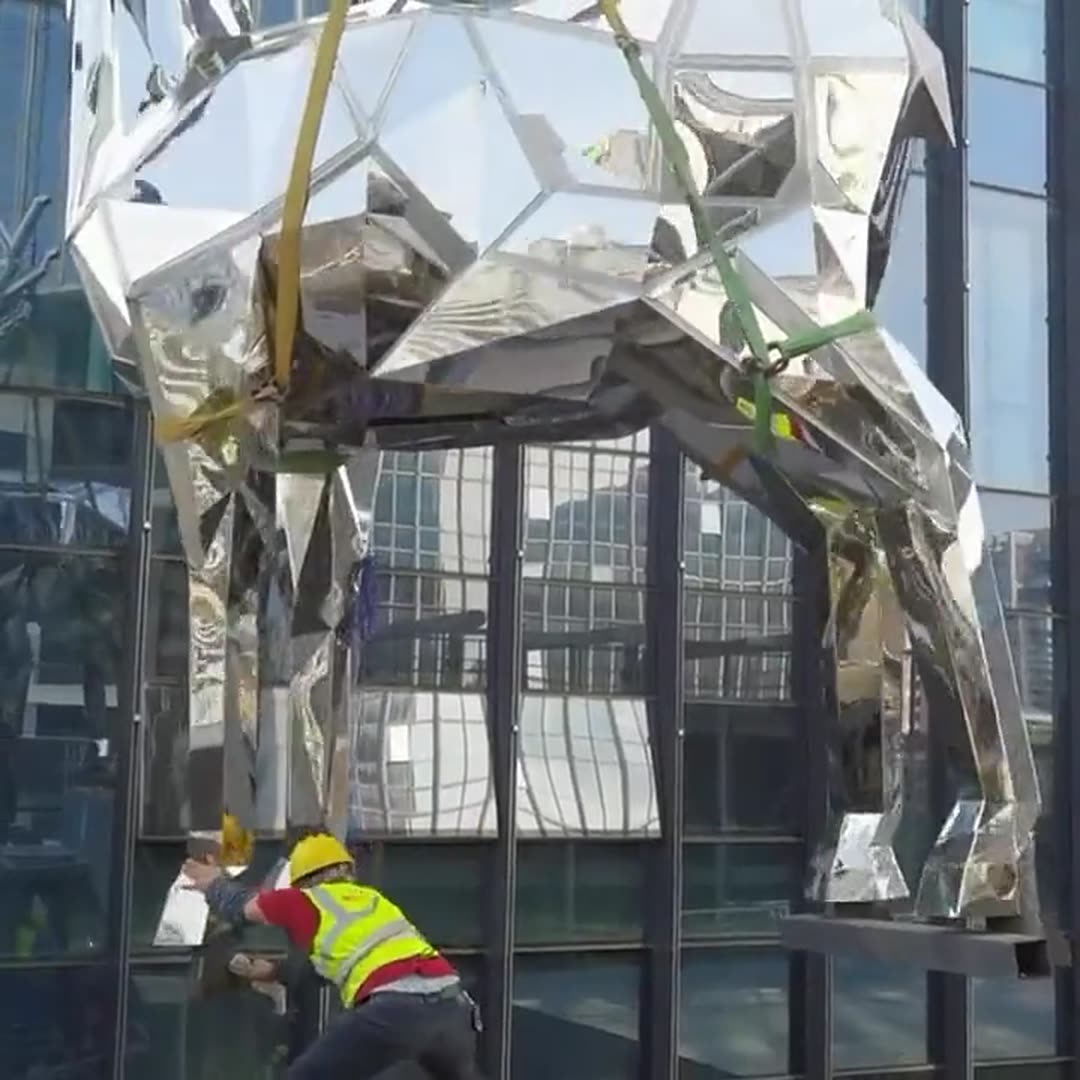
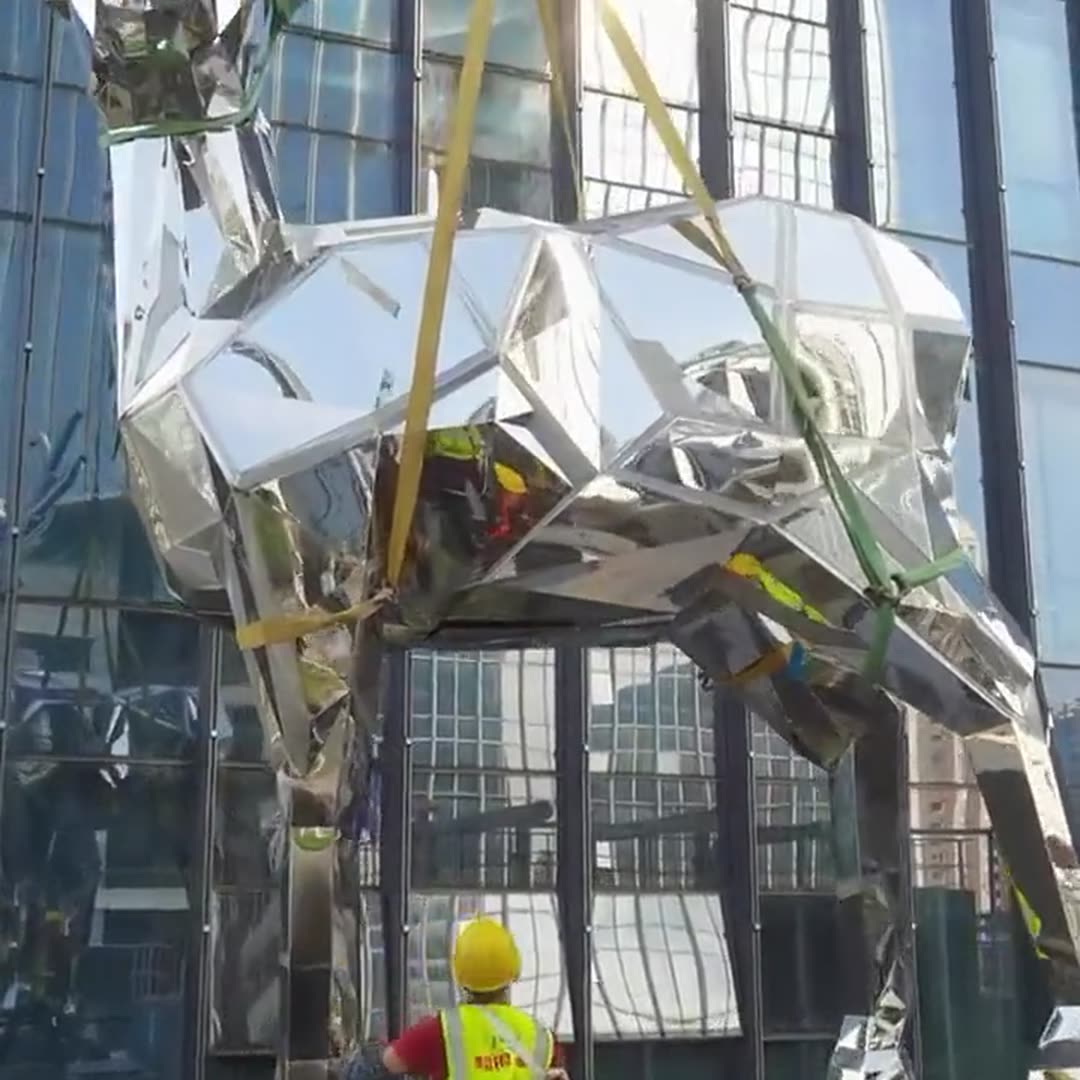
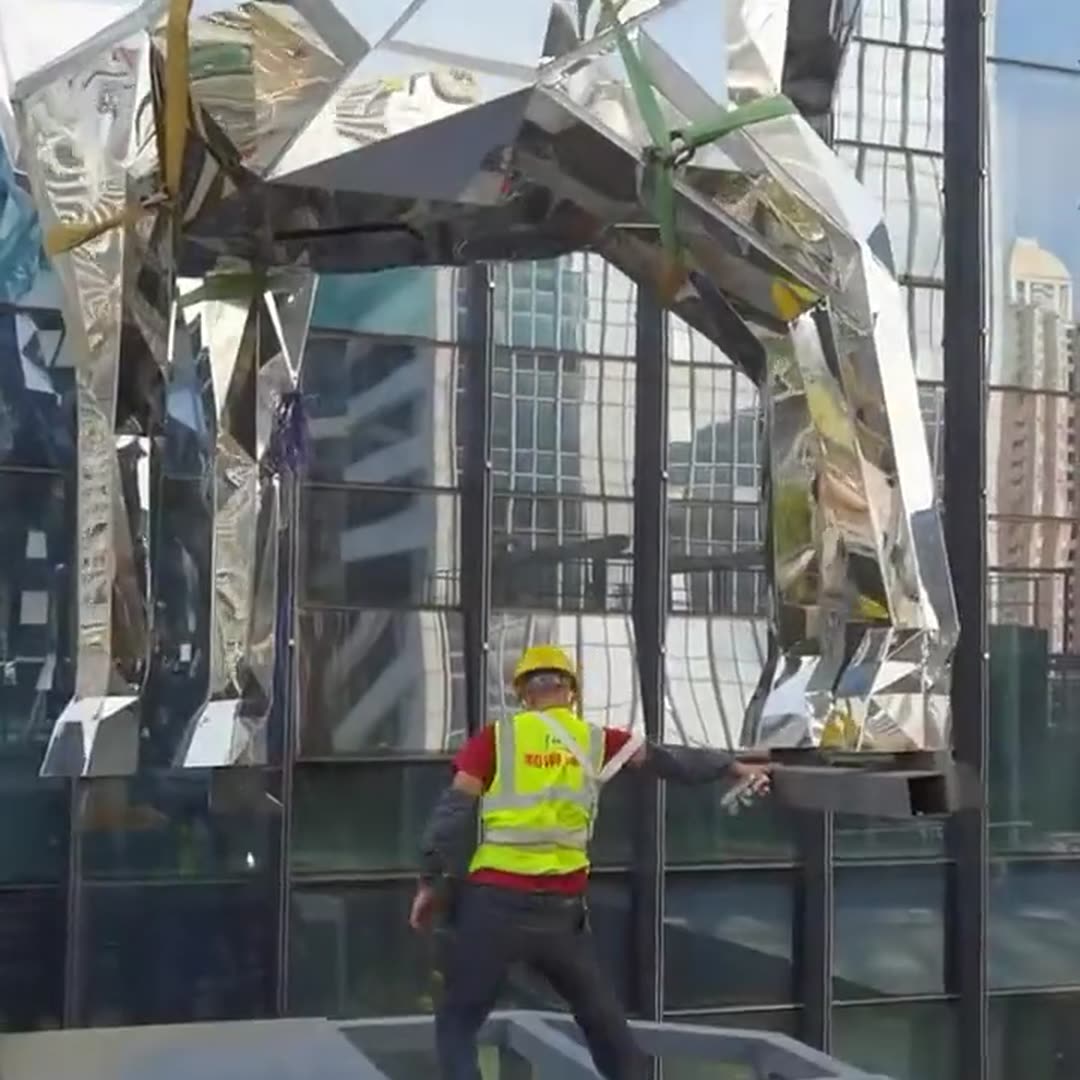
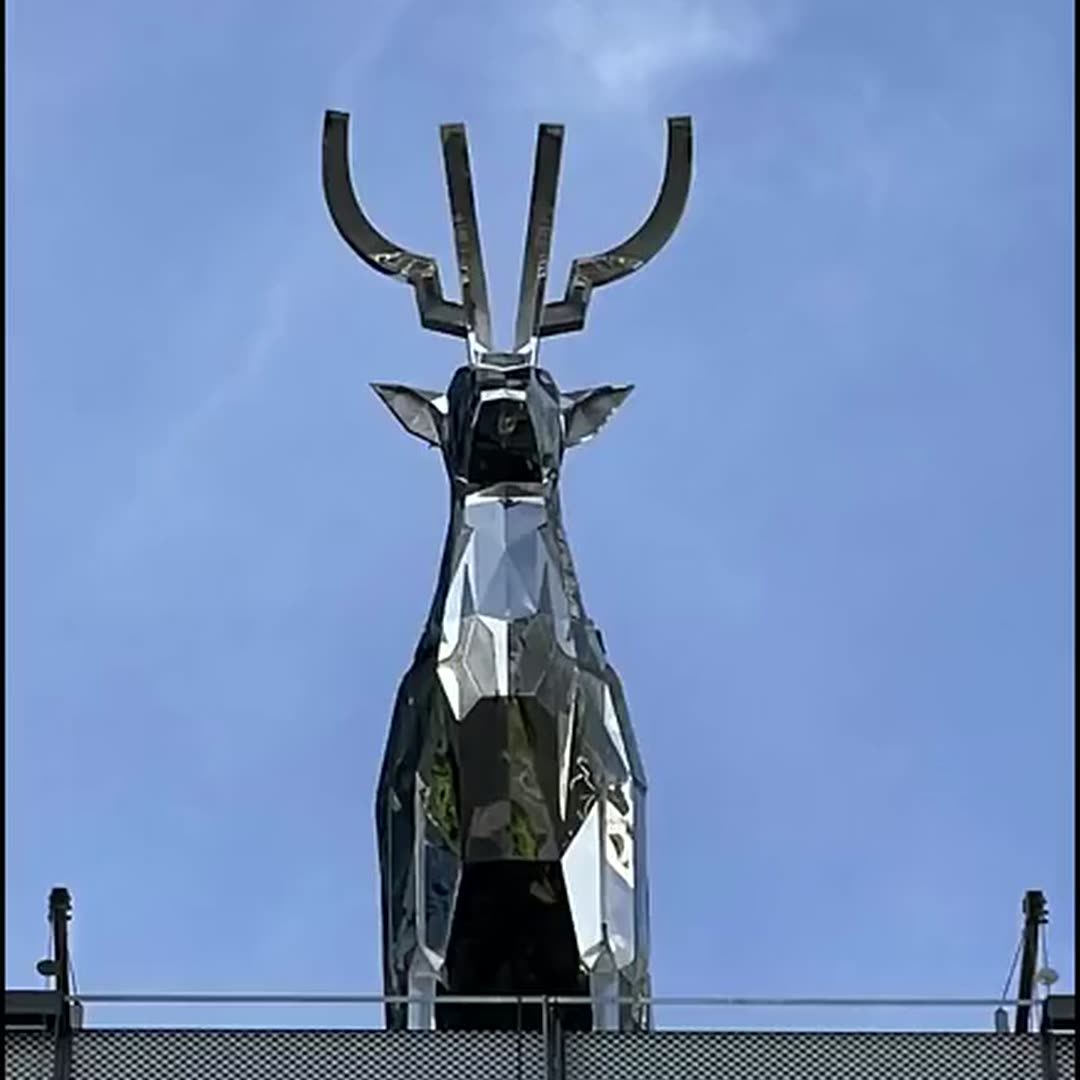
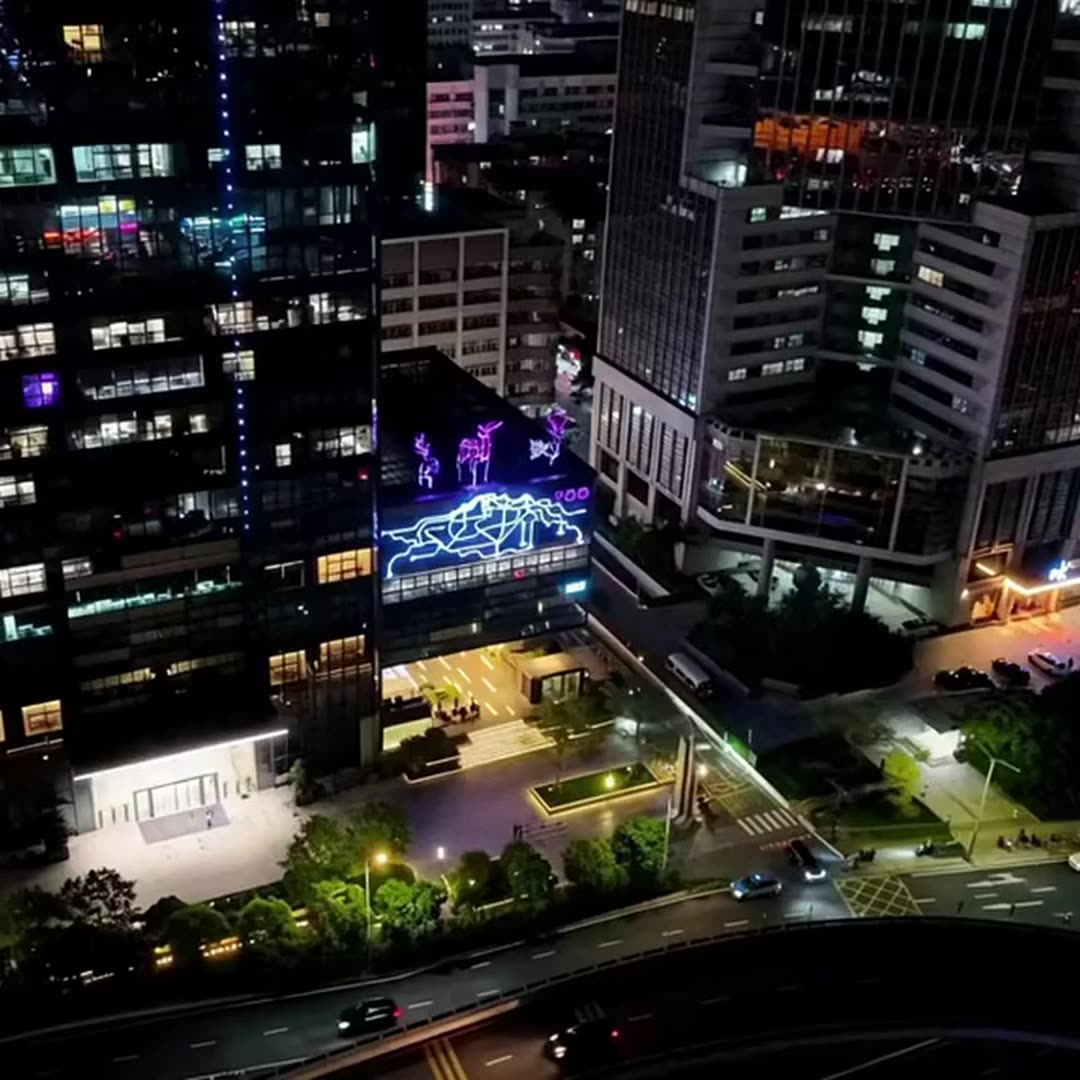
A giant faceted mirror-polished stainless-steel deer, craned into place beside a glass curtain-wall tower in Shenzhen — and the same site after dark, when the deer form is traced in programmable LED light. The square video above runs in order: crane lift, on-site rigging, the finished sculpture in daylight, then the night scene where the lighting takes over completely. It is a project case about a landmark treated as fabrication plus site engineering, not as a prop dropped onto a plaza.
Two readings of the same form are happening here. In daylight the animal is mass: a welded steel skeleton clad in faceted stainless-steel panels polished to a true mirror, so the body breaks the skyline into moving facets and throws the tower behind it straight back at the viewer. After dark the animal becomes line: the outline is traced in LED and the colour changes between scenes, which is what the aerial shot shows — the display glowing above the traffic and shopfronts of a dense city block. One silhouette, two completely different readings, both of them designed rather than accidental.
 |
 |
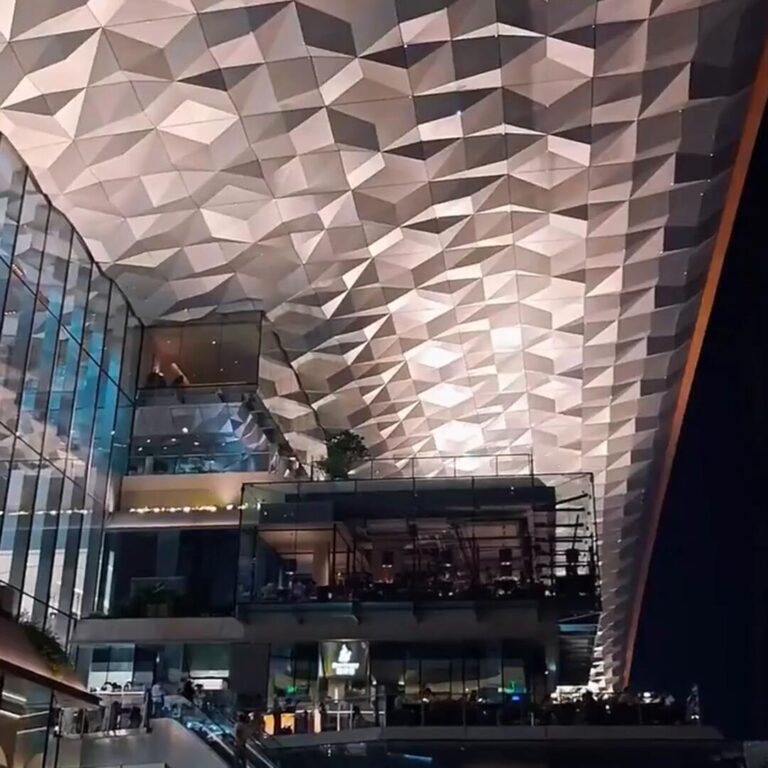
A mirror-finished sculpture is only as good as its geometry. A continuous double-curved form has to be formed and polished as one surface, and on an object this size every waviness in the substrate, every polishing line and every orange-peel defect shows up immediately as a distortion in the reflection. Faceting removes that problem at the source. Each panel is cut and press-brake formed from flat sheet, polished on its own bench, then fixed to the frame; the small angle between neighbouring facets does the work of describing the animal.
The second benefit is how the piece behaves in daylight. Flat facets sitting at slightly different angles means the sculpture never presents the same value twice — as the sun moves, panels flip from bright to dark, so the animal is legible from every approach instead of reading as one frozen photograph. The fragmentation also breaks the reflection into a pattern rather than a single smeared image of the sky, which is what keeps a mirror object interesting at this size in an open plaza.
 |
 |
Lifting a piece this size onto an occupied urban site is half of the job, and the part that decides whether it works. In the footage the mirror body comes in on rated slings with installers guiding it from below on harnesses, and the glass curtain wall is immediately behind the sculpture, so the rigging has to be planned against a fixed obstacle with no room to swing. It is set onto a prepared steel base frame that was installed and levelled before the lift, which is what makes the final alignment repeatable instead of a day of shimming.
Two details keep this maintainable after handover. Every facet is numbered against the CAD model, so a replacement panel later is a single spare part that fits first time. And the subframe is galvanised and bolted at the base rather than welded into the structure, so the sculpture can be serviced or removed without cutting into the building.
The lighting is the reason the piece reads as a corporate display rather than garden ornament. Contour lighting traces the facet edges and the deer’s silhouette, driven from a digital control system so the colour programme can be changed by scene rather than hard-wired. In the video it moves between cool cyan-blue and warm purple-magenta, and the same outline language carries into the graphics on the building face beside it — the light graphic and the lit object are designed as one composition, not as two separate commissions.
That is the real argument for a multi-surface approach. A solid mirror sculpture alone goes dark and flat after sunset, and on a site where most viewing happens in the evening that is most of the audience gone. Adding the programmable trace means the landmark is visible at its strongest in the hours when the plaza is actually used, and the building above it becomes part of the artwork rather than a backdrop.
 |
|
| Project | Giant deer sculpture, Vanke, Shenzhen |
| Project type | Outdoor public-art landmark, commercial site |
| Daytime surface | Faceted mirror-polished stainless steel panels on a welded steel skeleton |
| Nighttime surface | Programmable LED contour lighting, colour-changing scenes, integrated with facade graphics |
| Installation | Crane lift onto a prepared, levelled steel base frame, bolted fixings at the base |
| Setting | Open plaza / roof terrace immediately beside a glass curtain-wall tower |
Overall height, panel gauge, steel grade and the lighting control spec are set per project against the site and the client’s structural engineer, and ARTDSN issues the fabrication and structural package together rather than shipping a shell.
Have a landmark sculpture to fabricate? Send us the site, the 3D model or even a reference photo and we will come back with a fabrication route, a finish recommendation and a site-installation method. Talk to ARTDSN engineering.