


A kitchen worktop is the hardest-working surface in a building. Knives land on it, pots slide across it, grit gets dragged into every corner, and cleaning cloths wear it down a little every week. A brushed or mirror-polished stainless steel top will last for years, but it will not last invisibly: on a smooth surface every scratch is a bright hairline, and a hundred small marks read as neglect.
Scratch-resistant stainless steel solves that at the surface itself. Instead of a flat finish that records every mark, the sheet is embossed or etched with a fine, irregular texture. The texture breaks up the specular reflection, so a scratch that would be obvious on a mirror finish falls inside the grain of the surface and disappears. It is the same principle as a brushed or apple sand finish, but taken further: the pattern has enough depth and irregularity that ordinary kitchen use simply never reaches it.
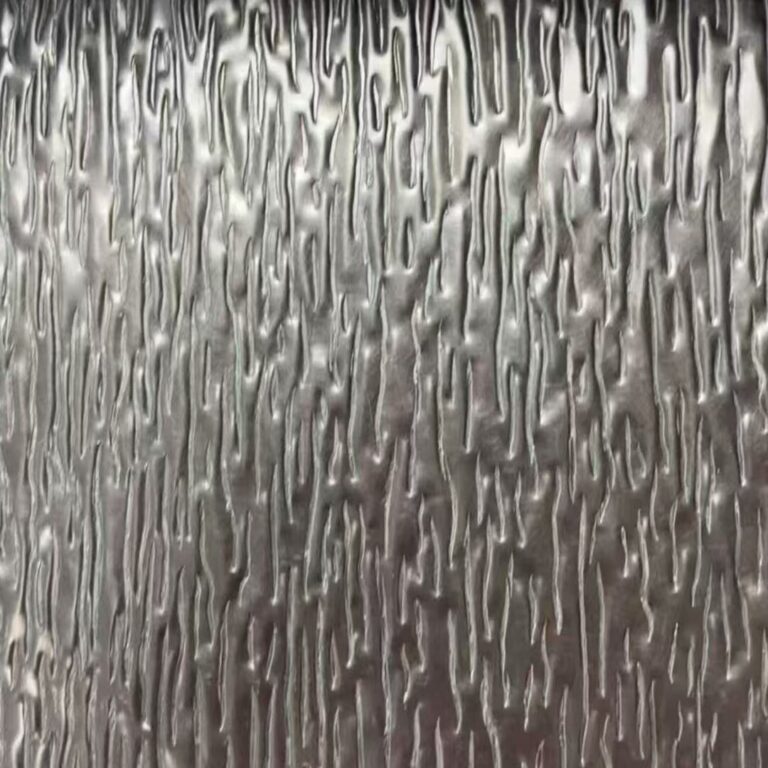
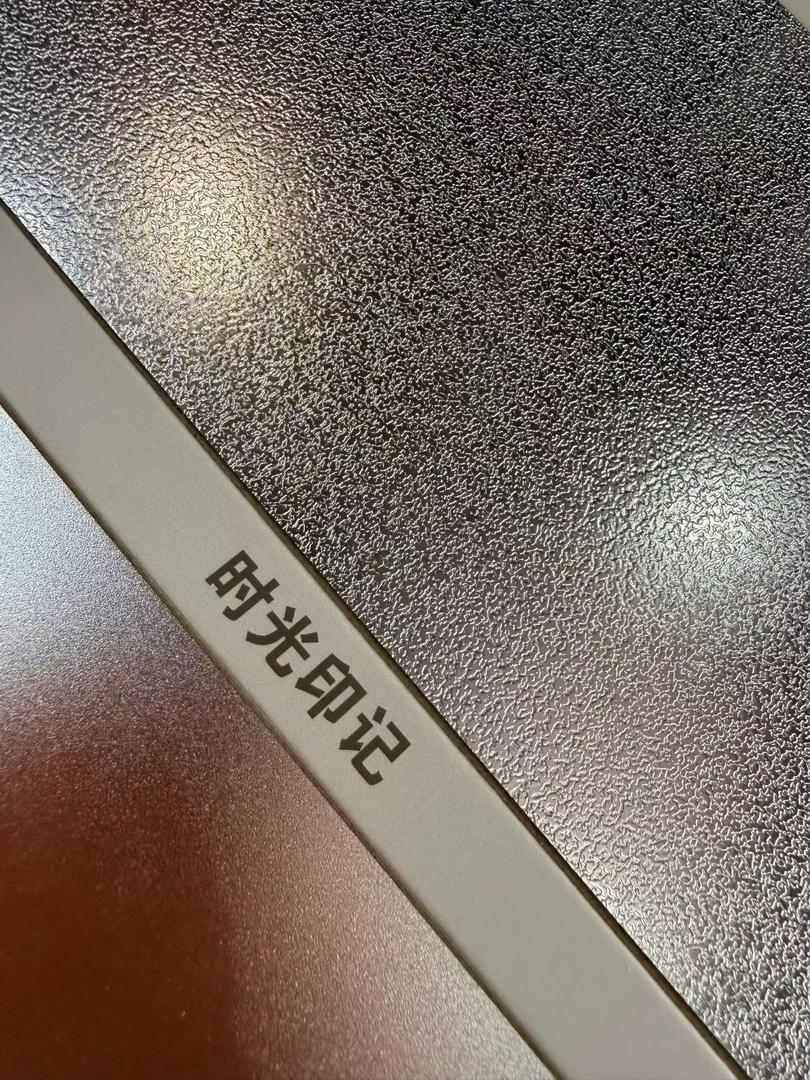
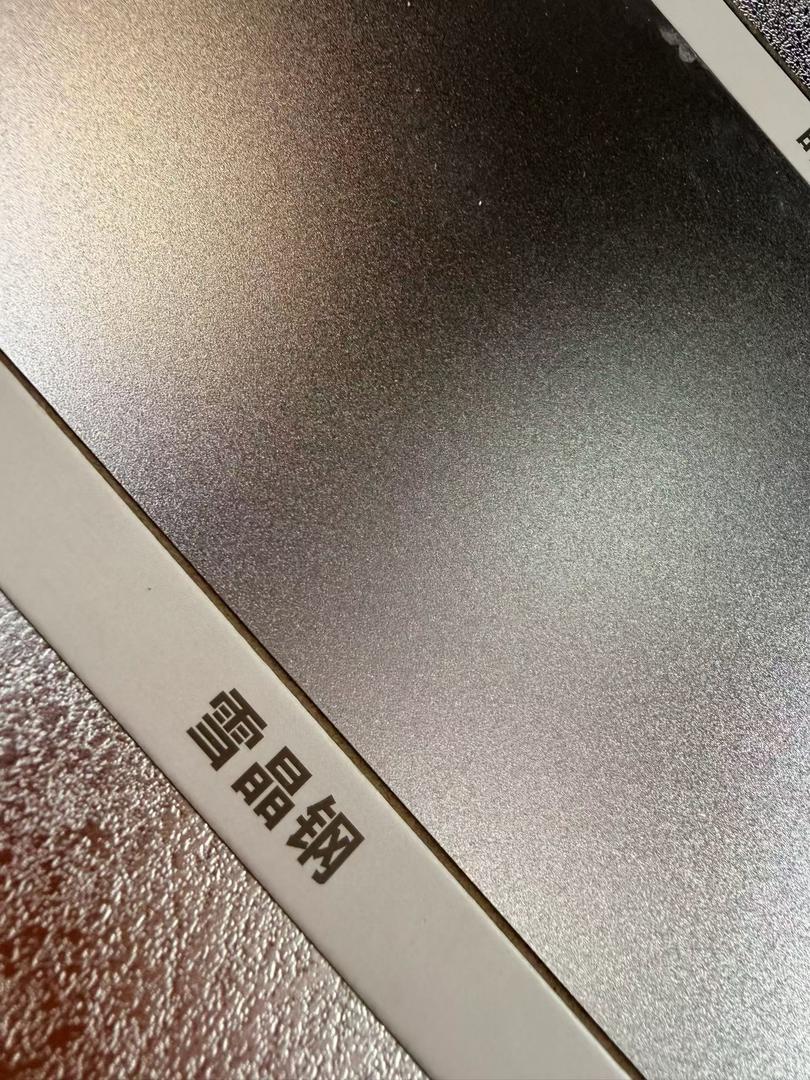
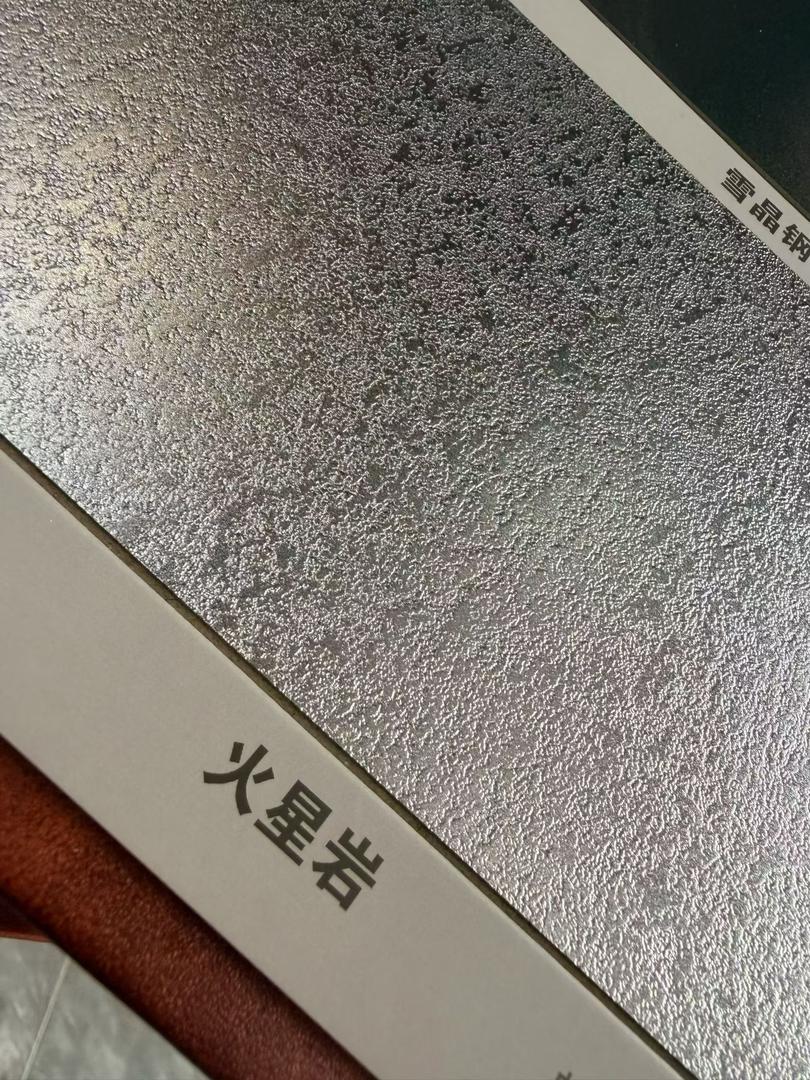
The photographs below are close-range views of our stock anti-scratch sheet, each one labelled as a scratch-resistant sample, followed by the same material after it has been fabricated into a finished worktop.
|
 |
These sheets are produced by two different process routes, and they behave differently once they are in a kitchen.
Embossed (pressed pattern). The relief is physically pressed into the sheet with matched tooling, so the texture has real depth and holds its own shadow. On a worktop it reads as a hammered or fine leather-grain surface. It hides scratches very well, shows fingerprints and water marks far less than a smooth finish, and it cannot be worn away, because the relief is the sheet itself rather than a coating sitting on top of it. This is the finish we normally specify for a working kitchen.
Etched (chemical pattern). The pattern is rolled into the surface by acid etching, producing a much finer, denser texture at essentially no change in sheet thickness. It is the quieter of the two: still genuinely anti-scratch, but restrained enough to read as a flat surface from across a room. Etched sheet is also the better choice when the panel has to be folded, because a fine grain tolerates a bend line without cracking open the way a deep emboss can.
Both are available in 304 and 316 grade. For coastal kitchens, outdoor counters and any installation where a salt-laden knife or a wet mop may sit on the surface for hours, we normally specify 316 — the molybdenum in 316 grade slows chloride pitting, which plain 304 will eventually show around a cut or a stubborn stain.
 |
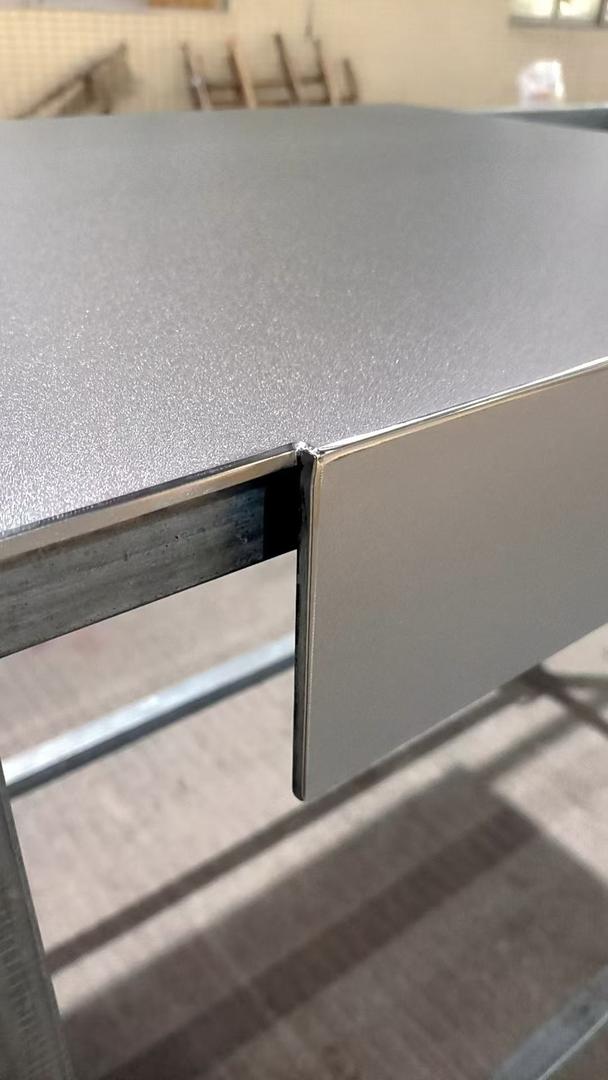 |
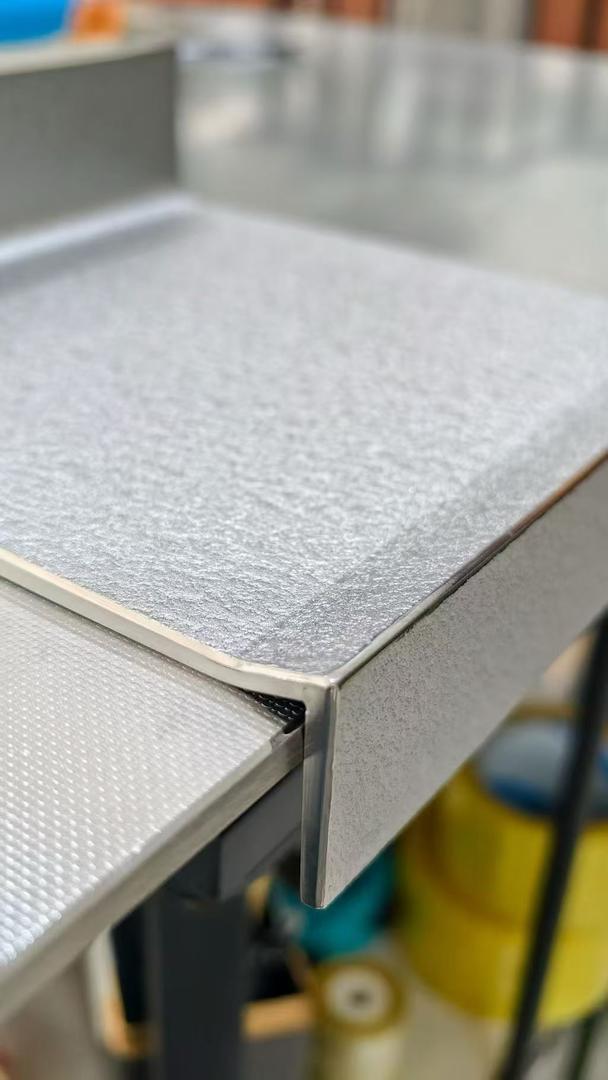
On a stainless steel countertop the surface is the easy part. The edge is what you touch every day, and it is what determines whether the top looks fabricated or looks cheap. In the two photos above you can see a worktop folded down and welded at the corner rather than mitred, which leaves a continuous radius and no seam line for grease to sit in. We fold returns up to 100 mm along the long edges and back edges so the top caps a cabinet carcass or a welded stainless base frame cleanly, and we grind and polish the fold so the front edge has no burr and no sharp corner.
If your base units are already built, we can supply the top as a flat blank at your exact finished size, pre-drilled if you need it, for your installer to drop in. If you want a one-piece top with upstands, coved upstands, a drainer groove or an integrated sink cut-out, that is fabricated in the same order.
 |
Stock gauge and width Thin sheet Thick plate |
We hold these grades permanently in stock, in both the embossed and the etched pattern, so most orders ship without waiting on a production run.
Thickness: 0.95 mm / 0.98 mm / 1.15 mm / 1.45 mm / 1.95 mm
Widths: 750 mm and 1250 mm
Thickness: 5 mm / 6 mm / 8 mm / 10 mm
Widths: 1250 mm and 1530 mm
Thickness is worth thinking about early, because it changes what the top can carry. Under 1 mm the sheet suits splashbacks, cabinet fronts, shelf returns and lightly worked surfaces. The 1.15–1.95 mm range is the practical choice for a residential kitchen worktop: rigid enough to span a cabinet carcass without a frame, still light enough to site by two people. At 5 mm and above you have moved from a surface to a fabricated structure — bar tops, commercial counters, equipment tables and shop counters that take real load — and at that gauge the top is usually welded to a stainless base frame rather than laid on one.
Residential kitchens. Worktops, sink surrounds, splashbacks and bar returns, in 304 grade for inland projects and 316 grade near the coast.
Commercial kitchens and restaurant pass counters. High-traffic surfaces that are washed down many times a day, where an etched or fine emboss is easier to keep presentable than a polished finish.
Bars and food counters. Bottles, knives, cans and constant wiping. Anti-scratch texture is the difference between a bar top that looks new after a year of service and one that looks tired after a month.
Laundry and utility rooms. A folding table, a shelf over a sink, a wall panel behind a washing machine — the same texture works as a work surface.
Retail and showroom counters. Where the top is the product display, a textured steel surface reads as engineered rather than as a domestic offcut.
Hospitals, laboratories and clean rooms. The surface can be wiped and disinfected repeatedly without the finish degrading or harbours dirt in an open grain.
Everything here is made to order as well as sold from stock. We cut to your finished size, form the returns, weld and grind the corners, drill fixing holes, and finish the surface in whichever of the stocked patterns you choose. Custom widths and non-standard gauges can be quoted separately; if you need a pattern that is not in our standard range we can emboss a matching roll from your sample.
Send us a sketch or a dimensioned drawing with the overall size, the edge detail, the base it has to sit on and the finish you want. We will come back with a price, a lead time and a delivery date.