


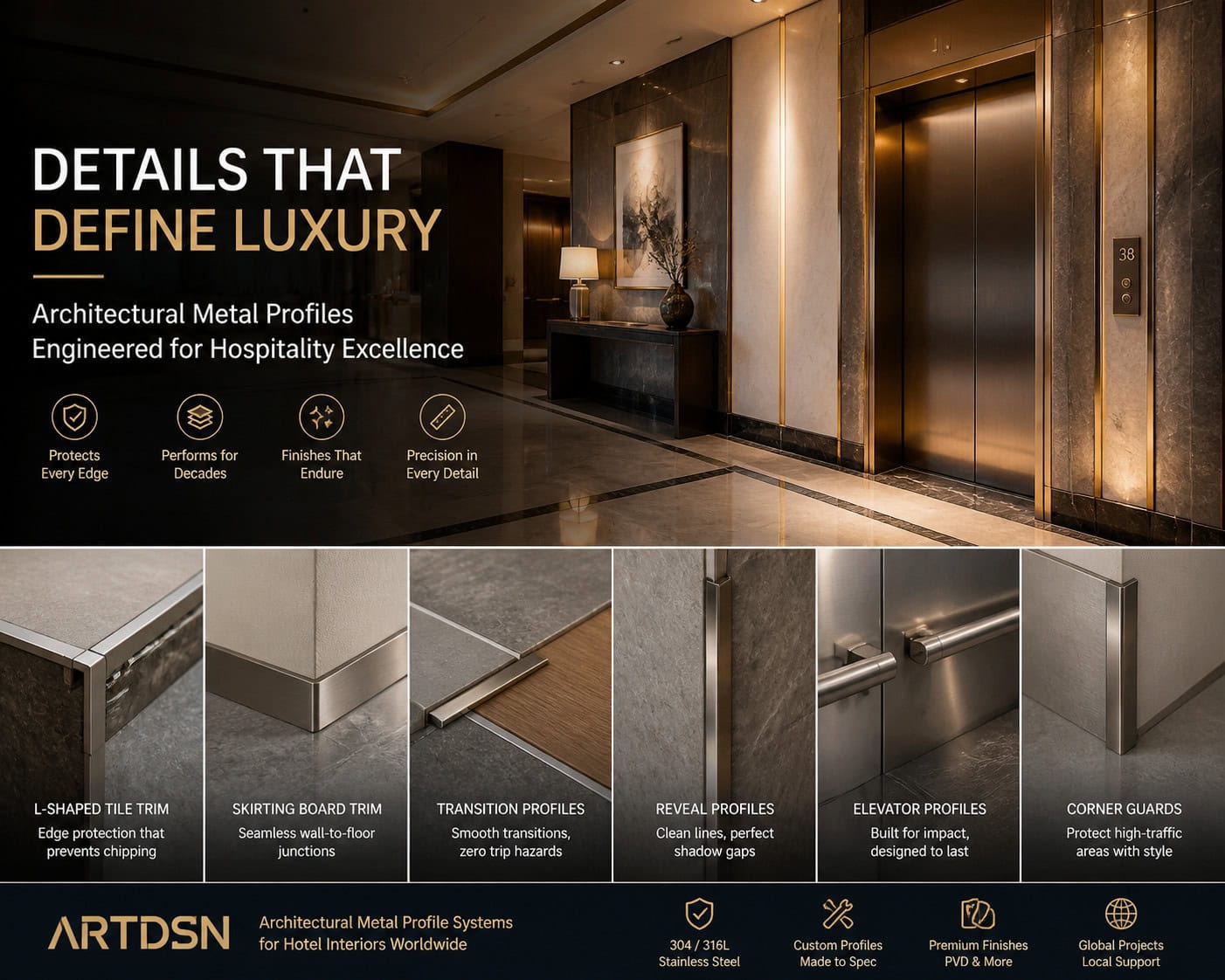
In five-star hospitality projects, the difference between a memorable space and an forgettable one often lives in the details that guests never consciously notice — the tile trim that creates a seamless wall-to-floor junction, the brushed stainless transition bar that prevents stone chipping at every corner, or the custom metal profile that frames an elevator lobby with millimeter precision. ARTDSN sits at this intersection: manufacturing the architectural metal profiles that make high-end hotel interiors look effortless.
Unlike decorative metal artistry (sculptures, feature walls, or ornamental screens), the profiles ARTDSN produces are infrastructure-grade components — they must perform structurally every day for decades while remaining visually imperceptible or elegantly understated.
Hospitality environments present a unique combination of stressors that consumer-grade materials cannot withstand:
Mechanical Load: Guest room corridors see hundreds of baggage and foot contacts per hour. Stone tiles without stainless steel edge protection chip within months. L-shaped tile trim profiles from ARTDSN distribute point-load impact across the trim geometry, preventing crack propagation into the tile body.
Hygrothermal Movement: Bathrooms experience rapid temperature swings (cold marble, hot shower steam) and sustained high humidity. Wood joinery adjacent to stone tiling expands and contracts at different rates. U-channel transition profiles accommodate this differential movement without cracking grout lines or delaminating adhesive bonds.
Chloride Exposure: In properties near swimming pools, spas, or coastal locations, chloride ions settle on all surfaces. Standard aluminum trim oxidizes within 18 months; ARTDSN specifies 316L stainless steel with electropolished finish for all wet-area profiles — molybdenum content resists pitting corrosion at chloride concentrations up to 25,000 ppm.
Maintenance Cycles: Hotel public areas are cleaned with aggressive chemical agents daily. Trims with painted or anodized coatings delaminate under repeated acidic/basic exposure. Brushed 304 stainless steel with a clear protective film maintains its finish through 10,000+ cleaning cycles with pH-neutral cleaner.
The guest bathroom is where material quality is most ruthlessly tested. Every exposed tile edge, every shower curb, every vanity-to-wall junction is touched or observed daily.
L-shaped edge trim protects exposed tile edges at shower compartments and bath tub perimeters. Installed during tile setting (not as afterthought), the trim becomes a structural part of the tile assembly — the perforated anchor leg keys into tile adhesive while the visible face provides a clean, rounded or square termination.
Skirting board trim connects floor tile to wall tile or wall paint at the floor/wall intersection. In high-end projects, this is a square-faced or slightly chamfered profile that mirrors the door architrave geometry — creating a coherent datum line around the entire room perimeter.
Schluter-style transition strips (T-profile and flat-profile) accommodate height differences between adjacent floor materials — tile to wood, tile to carpet, natural stone to engineered stone. ARTDSN manufactures these to ±0.1mm thickness tolerance, ensuring the transition is felt underfoot as a barely perceptible step rather than a trip hazard.
In corridor junctions where stone flooring meets gypsum bulkhead or where Wallpanel meets ceiling, stainless steel profile reveals create clean shadow gaps that visually separate materials without requiring sealant or silicone caulk — both of which yellow and crack within 2–3 years in hotel conditions.
ARTDSN’s reveal profiles are manufactured in 3-meter standard lengths with pre-punched fixing holes. On-site installation requires only adhesive or mechanical clips — no specialist welding or grinding needed.
Elevator interiors experience intense usage, baggage impact, and continuous vibration. ARTDSN supplies:
Not all metal profiles in a hotel are visible to guests. ARTDSN also supplies:
One of ARTDSN’s core capabilities for hospitality projects is custom cross-section profile design. A hotel brand may require:
Process:
For full hotel projects (200+ rooms), ARTDSN maintains a project-specific profile register — ensuring that all trim profiles across all room types, public areas, and back-of-house are traceable to the same production batch, finish standard, and dimensional tolerance.
Different hotel brand standards require different aesthetic approaches. ARTDSN supports the full finish spectrum:
| Finish Type | Aesthetic Character | Typical Application |
|---|---|---|
| No. 4 Brushed | Subtle directional sheen, hides scratches | Guest room corridors, bathroom trim |
| 8K Mirror | High-reflectivity, contemporary | Lobby cladding, elevator interiors |
| PVD Gold | Warm metallic luxury | Boutique and lifestyle hotels |
| PVD Rose Gold | Soft rose metallic | Soft-branded boutique properties |
| PVD Gunmetal / Black | Dark industrial luxury | Contemporary and adaptive reuse projects |
| Electropolished + Clear Coat | Maximum corrosion resistance + refined sheen | Pool areas, coastal properties, spa zones |
| Vibration-Distressed | Intentionally textured, artisanal character | Heritage and retro-fit hospitality conversions |
All PVD finishes achieve color batch consistency of ΔE ≤ 1.5 measured against the CIE Lab color space — ensuring that profiles manufactured 12 months apart for a multi-phase property expansion still match visually.
One of the distinct challenges in hospitality metal profiles is scale consistency. A 300-room hotel may require:
ARTDSN’s production capacity and project management process is built for this:
Major international hotel groups have committed to net-zero operational carbon by 2050. Metal profiles contribute to this in two ways:
Material efficiency: ARTDSN’s nesting and yield-optimisation process typically achieves above 94% material utilisation on standard profile runs. Scrap stainless steel is 100% recycled through the production loop — no material goes to landfill.
Longevity: A stainless steel tile trim installed correctly in a 2025 hotel project will not require replacement until at least 2075. This eliminates the material and labour cost of replacing PVC or aluminum trim every 8–12 years across a property’s 50-year operational life.
LEED and BREEAM contribution: Stainless steel profiles can contribute to credits under:
In hospitality design, the metal profiles that define tile transitions, guard wall corners, and frame elevator interiors are not decoration — they are the engineered infrastructure that keeps a space looking pristine through 20 years and 2 million guest arrivals. ARTDSN manufactures these profiles to tolerances and finish standards that make them invisible as components and unmistakable as quality. From concept through to the final room on the 38th floor, ARTDSN’s tile trim and metal profile systems give hotel operators the confidence that every detail has been resolved — before the first guest checks in.